Can AI be energy positive in cement manufacturing? Evaluating AI-driven efficiency through a first-order framework and case study
| Date Published |
09/2026
|
|---|---|
| Publication Type | Journal Article
|
| Authors | |
|---|---|
| DOI |
10.1016/j.egyai.2026.100789
|
| Abstract |
The growing energy demands of artificial intelligence (AI) systems have raised increasing concern, yet their deployment in manufacturing may offer opportunities to improve efficiency, reduce costs, and enhance productivity beyond traditional control systems. This study presents a structured, first-order analytical framework for evaluating the net energy and environmental implications of AI deployment in industrial settings, demonstrated through a sector-specific case study of dry process cement manufacturing. The analysis examines AI use cases across multiple manufacturing sectors and cross-cutting utility systems, focusing on process optimization, energy efficiency potential, additional environmental and non-energy impacts, deployment archetypes, and supporting service providers. In the cement case study, where advanced AI services are emerging commercially, energy savings across selected unit operations are assessed alongside the electricity consumption of AI infrastructure, considering multiple server configurations and sensitivity analyses across deployment scenarios. Under explicitly defined, assumption-driven scenarios, the results suggest that the broader energy and economic benefits of AI deployment in manufacturing could outweigh the associated energy use. For the cement case study, these modeled scenarios correspond to a potential reduction in primary energy demand and associated CO₂ emissions of approximately 3–9%. These findings remain contingent on key assumptions regarding system boundaries, deployment configurations, and operational performance, and should therefore be interpreted as indicative rather than empirically validated outcomes. Overall, the proposed framework provides a methodological foundation for systematically evaluating AI’s infrastructure energy requirements alongside its operational impacts, while the cement case study serves as an illustrative application to guide future empirical investigation and industrial decision-making. 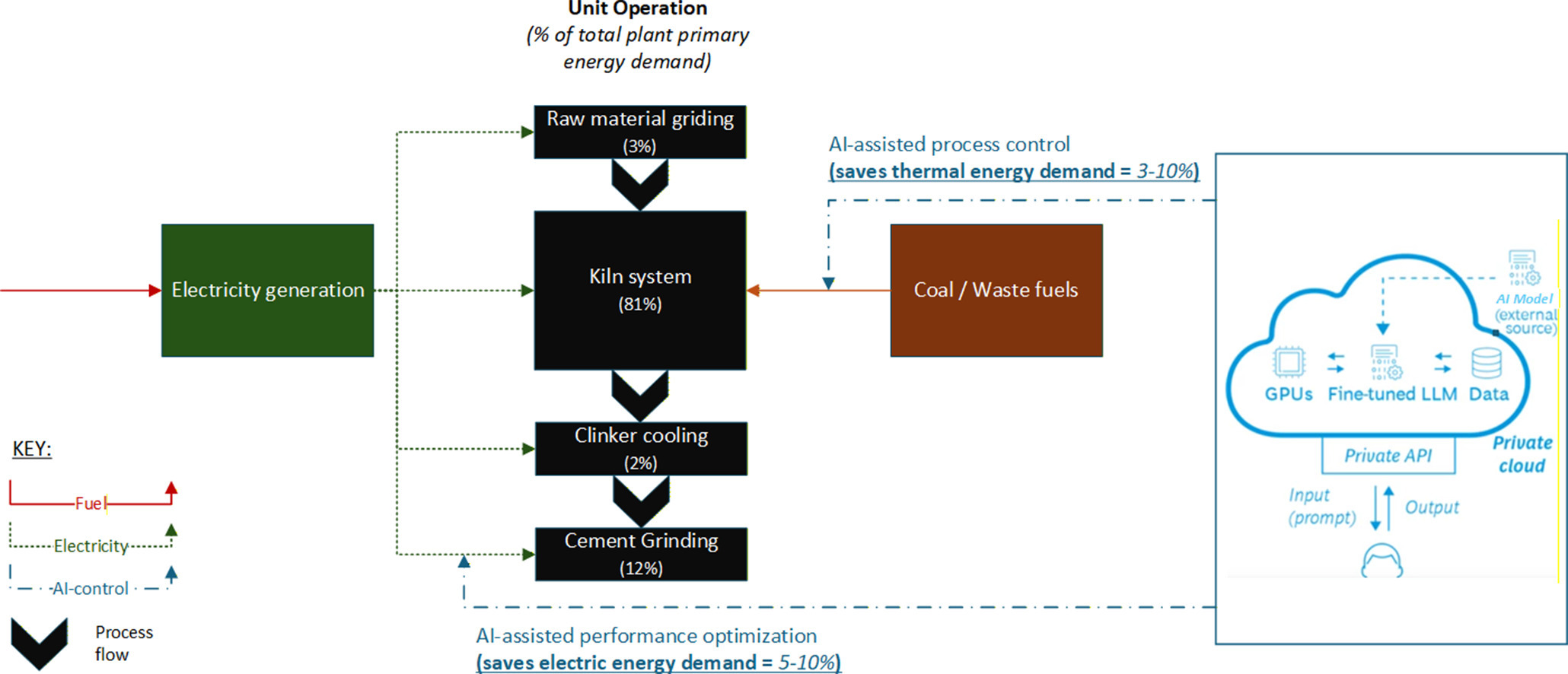 |
| Journal |
Energy and AI
|
| Volume |
25
|
| Year of Publication |
2026
|
| Pagination |
100789
|
| Publisher |
Elsevier BV
|
| ISSN Number |
2666-5468
|
| URL | |
| Keywords | |
| Organizations | |
| Research Areas | |
| Download citation | Google Scholar | DOI | BibTeX | Endnote tagged | RIS |